Review games
20 Questions
The class asks up to 20 yes-or-no questions to figure out a secret person, place or thing.
By subject
The best ESL games get every student speaking and listening, not just the confident ones. These games practice vocabulary, questions, directions and grammar with simple rules that are easy to explain to beginners.
The class asks up to 20 yes-or-no questions to figure out a secret person, place or thing.
Two students race to answer a flash card.
Partners sit back to back.
Write questions all over a beach ball and toss it around the room.
Each group gets a vegetable name, and the group that is called squats while chanting, then calls the next group to squat.
Pick a letter and a list of categories.
Students act out a word or phrase without speaking while their team guesses.
Students mark answers on a bingo card as you read clues.
Students find as many words as possible in a grid of letters.
Teams solve a chain of puzzles built from your unit content to unlock the final "lock" before time runs out.
Students search the room for hidden clues or items, answering questions to unlock the next clue.
A student describes a vocabulary word to their team without saying the word or any of the "taboo" words listed on the card.
Students choose three items they would bring to a desert island and justify their picks.
Students walk around with a grid of prompts and find a classmate who matches each one.
Teams guess the same bowl of words in three rounds: first with any clues, then with one-word clues, then with acting only.
Two students race to swat the correct answer on the board with a fly swatter.
After reading The Gingerbread Man, students follow clues around the school to find the runaway cookie.
Teams answer review questions to win the right to erase X's from other teams, then take a bonus shot at a trash can to erase even more.
Students guess letters to reveal a hidden word before the drawing is complete.
One student holds a word card to their forehead without looking at it, and classmates give clues until they guess the word.
Students pass an object around while music plays.
One student sits with their back to the board while teammates describe the word written behind them.
Give a clue about something in the room and students guess what it is.
Students stand in two circles facing a partner, answer a question together, then the outer circle moves on to a new partner.
Color-code Jenga blocks to question cards.
A quiz-show board of categories and point values where teams pick a square and answer the question behind it.
Students take turns pulling craft sticks from a cup and read the word or answer the question on each one, keeping every stick they get right.
Students study a tray of objects for one minute, then the tray is covered and one object is removed.
The teacher says a word loudly and the class repeats it quietly, or says it quietly and the class says it back loudly.
Students supply nouns, verbs and adjectives without seeing the story, then read the silly result aloud.
A secret-role game where the "mafia" tries to eliminate townspeople at night while the town debates and votes by day.
Students flip cards two at a time to find matching pairs, such as a word and its definition.
One blindfolded student walks through an obstacle course guided only by a partner's voice.
Students walk around the room saying "mingle, mingle" until the teacher calls a number, then quickly form groups of exactly that size.
A student feels an object inside a bag without looking and describes it while classmates guess.
Show four words, numbers or pictures and ask students which one does not belong and why.
A gift wrapped in many layers is passed around while music plays.
Students physically move to the side of the room that matches their view on a debatable statement, then argue respectfully, moving if they change their mind.
One student draws a word on the board while their team guesses it before time runs out.
A Halloween twist on hot potato: pass a small pumpkin around the circle while music plays, and whoever holds it when the music stops answers a question.
Each student holds a question card, quizzes a partner, gets quizzed back, then trades cards and finds a new partner.
Students answer the task card on their desk, then "scoot" to the next desk on your signal and answer the next card.
Students follow commands only when they start with "Simon says".
Students spell a word aloud one letter at a time around the circle.
Students take turns spelling words aloud.
The class builds a story one sentence at a time, each student adding to what came before.
A whispered message travels down a line of students and usually comes out hilariously different.
A sentence turns into a drawing, then a sentence, then a drawing, as papers pass around a group.
The class works through the alphabet naming one thing they are thankful for per letter.
Students take as many squares of toilet paper as they "think they will need" without knowing why.
A fast two-choice warm-up: pizza or tacos, summer or winter.
Two teams play tic-tac-toe on the board, but must answer a question correctly to place their X or O.
The teacher picks a row of students as the "train", and each student answers in turn without a pause, like cars passing one after another.
Each student shares three statements about themselves, one of them false, and the class guesses the lie.
Students creep toward the wolf, taking as many steps as the hour the wolf calls out.
Every student writes an answer on a mini whiteboard, and the whole class holds their boards up at the same moment on the teacher's "Showdown" signal.
A student holds a card to their forehead without seeing it and asks yes-or-no questions to figure out which person, animal or term they are.
Run a quiz show with mini whiteboards: every student answers every question at the same time, so nobody sits out.
Each student says a word that starts with the last letter of the previous word: apple, egg, giraffe.
Change one letter at a time to turn one word into another: CAT to COT to DOT to DOG.
Teams race to unscramble vocabulary words.
Give students two choices and have them pick a side of the room, then explain their reasoning.
Quick picks
Question sets
Play any set in the online games, run a live quiz or print it as a worksheet.
Play online
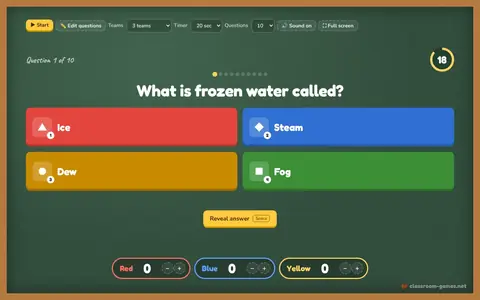 Quiz ShowKahoot-style questions with colors, a countdown and team points. No student devices.▶ Play now
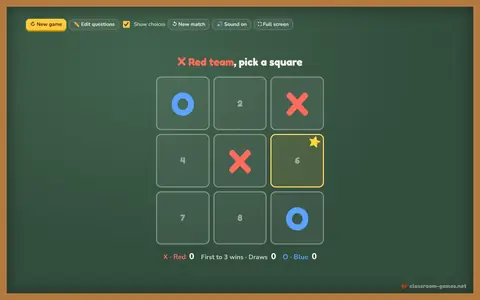 Tic Tac Toe ReviewAnswer a question to claim the square. Red X vs Blue O.▶ Play now
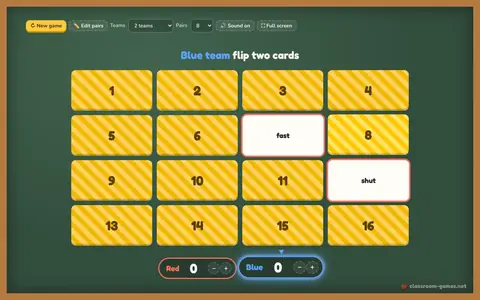 Memory MatchFlip two cards, find the pair. Words, facts or translations.▶ Play now
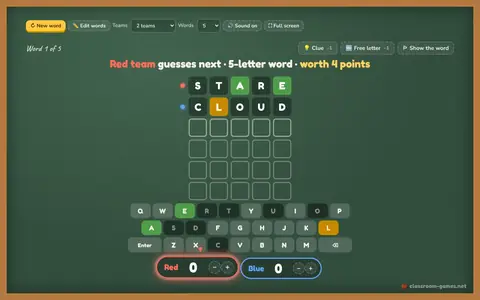 Guess the WordWordle with your own spelling words, hints and team turns.▶ Play now
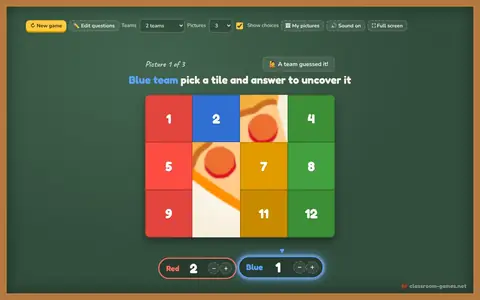 Mystery PictureAnswer questions to remove tiles. First team to guess the picture wins.▶ Play now
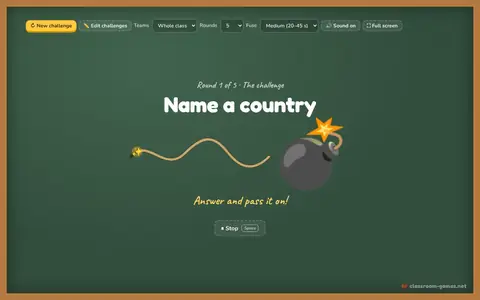 Pass the BombA hidden random fuse, a challenge and a ball to pass. Boom!▶ Play now
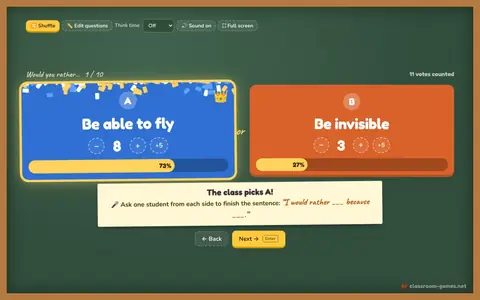 Would You Rather VoteBig A vs B choices, count the votes, reveal the result.▶ Play now
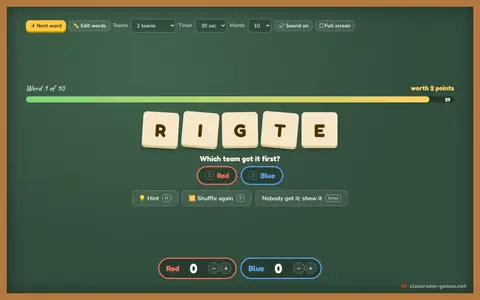 Word ScrambleUnscramble the letters before the timer runs out.▶ Play now
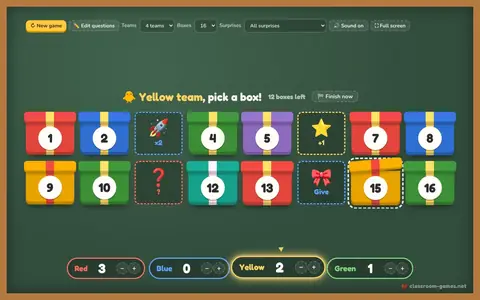 Lucky BoxesPick a box, answer right, open it: points, steal, swap or 💣.▶ Play now
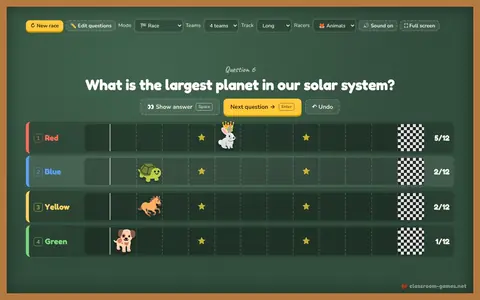 Team RaceAnswer right to move your racer. First to the flag wins. Or play tug of war.▶ Play now
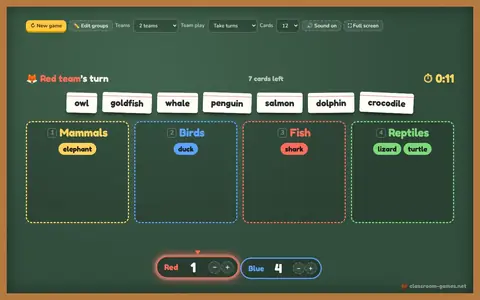 Sort ItDrag each card into the right group on the board. Teams or beat the clock.▶ Play now
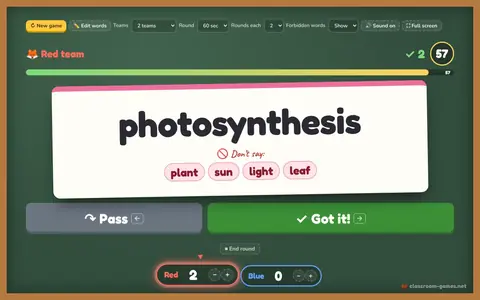 Heads UpBig word cards, 60-second rounds, ✓ got it or ↷ pass. Charades and Taboo too.▶ Play now
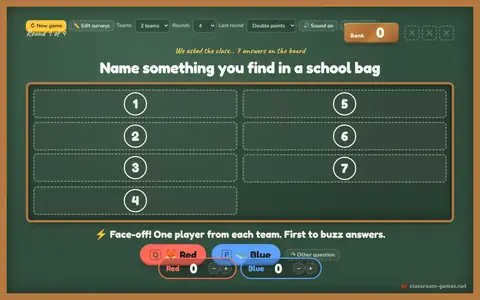 Survey SaysGuess the top survey answers. Face-off, three strikes, steal the bank.▶ Play now
Board tools
Questions teachers ask
Hot Seat, Word Chain, Simon Says, Categories (Stop the Bus) and 20 Questions need no materials and get students talking.
Put sentence frames on the board, allow gestures, and let students play in pairs before speaking in front of the class.
Explore