Team building
Back-to-Back Drawing
Partners sit back to back.
By type
Team-building games give students a shared challenge and a reason to listen to each other. Run one at the start of a group project or whenever your class needs to reconnect.
Partners sit back to back.
The class works together to keep a balloon in the air, counting every tap.
Teams line up and take turns running to the board to answer one step of a problem, then hand the marker to the next teammate.
Students act out a word or phrase without speaking while their team guesses.
Teams solve a chain of puzzles built from your unit content to unlock the final "lock" before time runs out.
Students search the room for hidden clues or items, answering questions to unlock the next clue.
A student describes a vocabulary word to their team without saying the word or any of the "taboo" words listed on the card.
Two teams answer questions to drop a colored token into a grid on the board.
The class counts to 20 one voice at a time without planning who goes next.
Teams stack plastic cups into the tallest tower, or a Christmas tree shape, without touching them with their hands.
Students choose three items they would bring to a desert island and justify their picks.
Teams hear surprising statements and decide whether each one is fact or fiction.
Teams guess the same bowl of words in three rounds: first with any clues, then with one-word clues, then with acting only.
Two students race to swat the correct answer on the board with a fly swatter.
After reading The Gingerbread Man, students follow clues around the school to find the runaway cookie.
Teams answer review questions to win the right to erase X's from other teams, then take a bonus shot at a trash can to erase even more.
One student sits with their back to the board while teammates describe the word written behind them.
Students hold hands across a circle to make a tangle, then work together to untangle without letting go.
Students stand in two circles facing a partner, answer a question together, then the outer circle moves on to a new partner.
A quiz-show board of categories and point values where teams pick a square and answer the question behind it.
A secret-role game where the "mafia" tries to eliminate townspeople at night while the town debates and votes by day.
Teams build the tallest freestanding tower from spaghetti, tape and string that can hold a marshmallow on top.
Teams "bat" by answering questions: easy for a single, harder for a double, hardest for a home run.
One blindfolded student walks through an obstacle course guided only by a partner's voice.
Students try quick one-minute challenges with everyday items, like stacking cups into a pyramid or moving paper squares with a straw.
Partners face each other.
Teams race to wrap one teammate head to toe in toilet paper like a mummy.
Students physically move to the side of the room that matches their view on a debatable statement, then argue respectfully, moving if they change their mind.
Students line up in order by birthday, height or name without talking.
The class builds a story one sentence at a time, each student adding to what came before.
A whispered message travels down a line of students and usually comes out hilariously different.
A sentence turns into a drawing, then a sentence, then a drawing, as papers pass around a group.
Two teams play tic-tac-toe on the board, but must answer a question correctly to place their X or O.
Teams answer review questions, and every correct answer earns a shot at the trash can for bonus points.
Every student writes an answer on a mini whiteboard, and the whole class holds their boards up at the same moment on the teacher's "Showdown" signal.
Students pass "zip", "zap" and "zop" around a circle in order, faster and faster.
Quick picks
Play online
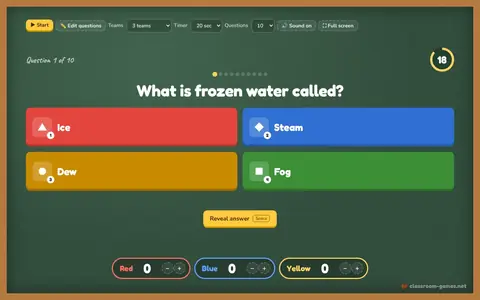 Quiz ShowKahoot-style questions with colors, a countdown and team points. No student devices.▶ Play now
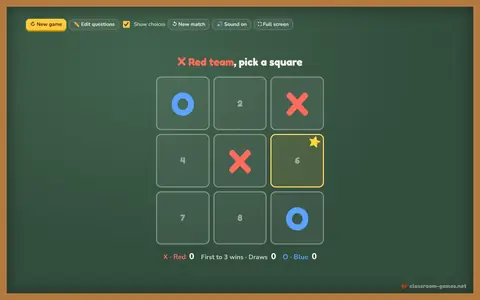 Tic Tac Toe ReviewAnswer a question to claim the square. Red X vs Blue O.▶ Play now
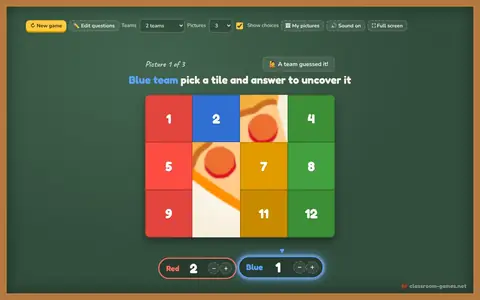 Mystery PictureAnswer questions to remove tiles. First team to guess the picture wins.▶ Play now
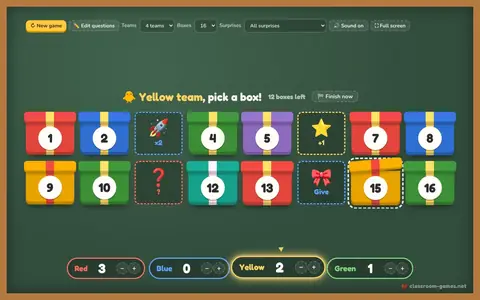 Lucky BoxesPick a box, answer right, open it: points, steal, swap or 💣.▶ Play now
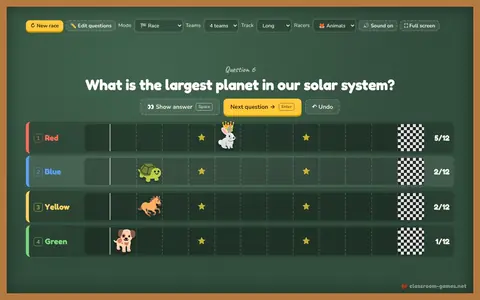 Team RaceAnswer right to move your racer. First to the flag wins. Or play tug of war.▶ Play now
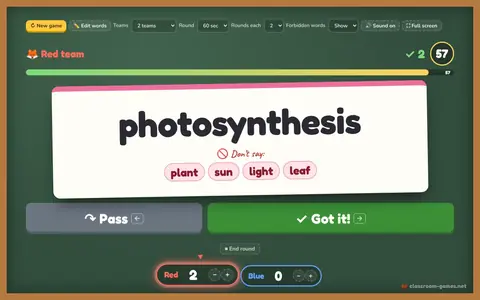 Heads UpBig word cards, 60-second rounds, ✓ got it or ↷ pass. Charades and Taboo too.▶ Play now
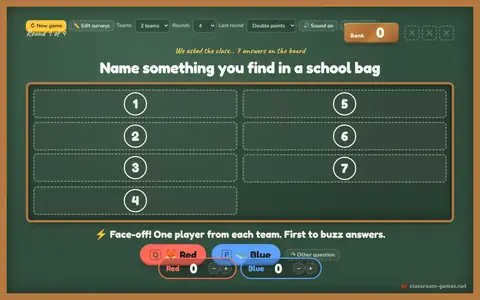 Survey SaysGuess the top survey answers. Face-off, three strikes, steal the bank.▶ Play now
Board tools
Questions teachers ask
The Marshmallow Challenge, Human Knot, Silent Line-Up and Minefield all require teams to communicate and plan.
Yes. Ask what worked, what did not, and what the team would do differently. That is where most of the learning happens.
Explore