Review games
20 Questions
The class asks up to 20 yes-or-no questions to figure out a secret person, place or thing.
By grade
Middle schoolers want games that feel grown up, social and a little competitive. These games work for unit reviews, the first week of school and the last ten minutes of class, without feeling babyish.
The class asks up to 20 yes-or-no questions to figure out a secret person, place or thing.
Two students race to answer a flash card.
Partners sit back to back.
The class works together to keep a balloon in the air, counting every tap.
Write questions all over a beach ball and toss it around the room.
Teams line up and take turns running to the board to answer one step of a problem, then hand the marker to the next teammate.
Students count around the room but say "Buzz" instead of any multiple of a chosen number.
Students estimate how many candies are in a jar, explain their strategy, then count together.
Each group gets a vegetable name, and the group that is called squats while chanting, then calls the next group to squat.
Pick a letter and a list of categories.
Students act out a word or phrase without speaking while their team guesses.
Each student says a four-character Chinese idiom (chengyu) that starts with the last character of the one before it, such as 一心一意 → 意气风发 → 发奋图强.
Students mark answers on a bingo card as you read clues.
Students find as many words as possible in a grid of letters.
Teams solve a chain of puzzles built from your unit content to unlock the final "lock" before time runs out.
Students search the room for hidden clues or items, answering questions to unlock the next clue.
A student describes a vocabulary word to their team without saying the word or any of the "taboo" words listed on the card.
Two teams answer questions to drop a colored token into a grid on the board.
The class counts to 20 one voice at a time without planning who goes next.
Teams stack plastic cups into the tallest tower, or a Christmas tree shape, without touching them with their hands.
Students choose three items they would bring to a desert island and justify their picks.
Teams hear surprising statements and decide whether each one is fact or fiction.
Students walk around with a grid of prompts and find a classmate who matches each one.
Teams guess the same bowl of words in three rounds: first with any clues, then with one-word clues, then with acting only.
Two students race to swat the correct answer on the board with a fly swatter.
Students tiptoe to one of four labeled corners while a caller with eyes closed picks a corner.
Teams answer review questions to win the right to erase X's from other teams, then take a bonus shot at a trash can to erase even more.
Students guess a secret number and get clues like "higher" or "lower", or math clues like "it is a multiple of 4".
Students guess letters to reveal a hidden word before the drawing is complete.
One student holds a word card to their forehead without looking at it, and classmates give clues until they guess the word.
Seven students secretly tap classmates with their heads down, then the tapped students guess who tapped them.
The class guesses whether the next card or number will be higher or lower than the last one, showing their guess with their hands or by moving.
Students pass an object around while music plays.
One student sits with their back to the board while teammates describe the word written behind them.
Students hold hands across a circle to make a tangle, then work together to untangle without letting go.
Students stand in two circles facing a partner, answer a question together, then the outer circle moves on to a new partner.
Color-code Jenga blocks to question cards.
A quiz-show board of categories and point values where teams pick a square and answer the question behind it.
Students take turns pulling craft sticks from a cup and read the word or answer the question on each one, keeping every stick they get right.
Students study a tray of objects for one minute, then the tray is covered and one object is removed.
Students supply nouns, verbs and adjectives without seeing the story, then read the silly result aloud.
A secret-role game where the "mafia" tries to eliminate townspeople at night while the town debates and votes by day.
Students use four numbers and any operations to make exactly 24.
Teams build the tallest freestanding tower from spaghetti, tape and string that can hold a marshmallow on top.
Teams "bat" by answering questions: easy for a single, harder for a double, hardest for a home run.
Pairs flip playing cards and race to add or multiply them.
Students flip cards two at a time to find matching pairs, such as a word and its definition.
One blindfolded student walks through an obstacle course guided only by a partner's voice.
Students walk around the room saying "mingle, mingle" until the teacher calls a number, then quickly form groups of exactly that size.
Students try quick one-minute challenges with everyday items, like stacking cups into a pyramid or moving paper squares with a straw.
Partners face each other.
Teams race to wrap one teammate head to toe in toilet paper like a mummy.
Students stand in a circle in ninja poses and take turns making one swift move to tap another player's hand.
Show four words, numbers or pictures and ask students which one does not belong and why.
A gift wrapped in many layers is passed around while music plays.
Students physically move to the side of the room that matches their view on a debatable statement, then argue respectfully, moving if they change their mind.
One student draws a word on the board while their team guesses it before time runs out.
Each student holds a question card, quizzes a partner, gets quizzed back, then trades cards and finds a new partner.
Students play rock paper scissors, and losers become the cheering section of the winner.
Students answer the task card on their desk, then "scoot" to the next desk on your signal and answer the next card.
Students toss a soft ball around the room without making a sound.
Students line up in order by birthday, height or name without talking.
Students write an answer or question on paper, crumple it up and throw it across the room.
Students spell a word aloud one letter at a time around the circle.
Students take turns spelling words aloud.
A "splatter" in the middle of the circle points at a student, who must duck right away.
Read a statement.
A circle clapping game: students pass a clap around while chanting, and whoever is clapped on the final count is out.
The class builds a story one sentence at a time, each student adding to what came before.
A whispered message travels down a line of students and usually comes out hilariously different.
A sentence turns into a drawing, then a sentence, then a drawing, as papers pass around a group.
The class works through the alphabet naming one thing they are thankful for per letter.
Each student says their name plus an alliterative word ("Jumping Jada"), and the next student repeats all the names before theirs.
Students take as many squares of toilet paper as they "think they will need" without knowing why.
A fast two-choice warm-up: pizza or tacos, summer or winter.
Two teams play tic-tac-toe on the board, but must answer a question correctly to place their X or O.
The teacher picks a row of students as the "train", and each student answers in turn without a pause, like cars passing one after another.
Teams answer review questions, and every correct answer earns a shot at the trash can for bonus points.
Each student shares three statements about themselves, one of them false, and the class guesses the lie.
Every student writes an answer on a mini whiteboard, and the whole class holds their boards up at the same moment on the teacher's "Showdown" signal.
A student holds a card to their forehead without seeing it and asks yes-or-no questions to figure out which person, animal or term they are.
Run a quiz show with mini whiteboards: every student answers every question at the same time, so nobody sits out.
Each student says a word that starts with the last letter of the previous word: apple, egg, giraffe.
Change one letter at a time to turn one word into another: CAT to COT to DOT to DOG.
Teams race to unscramble vocabulary words.
Give students two choices and have them pick a side of the room, then explain their reasoning.
Students pass "zip", "zap" and "zop" around a circle in order, faster and faster.
Quick picks
Question sets
Play any set in the online games, run a live quiz or print it as a worksheet.
Play online
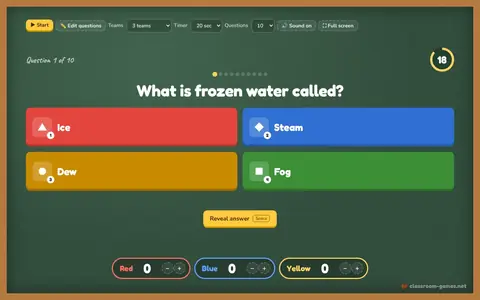 Quiz ShowKahoot-style questions with colors, a countdown and team points. No student devices.▶ Play now
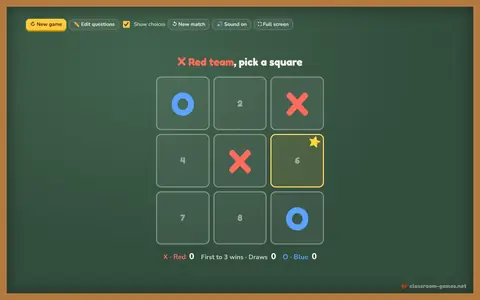 Tic Tac Toe ReviewAnswer a question to claim the square. Red X vs Blue O.▶ Play now
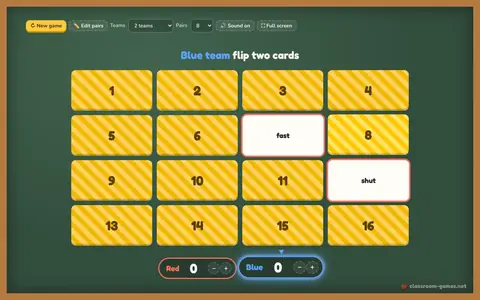 Memory MatchFlip two cards, find the pair. Words, facts or translations.▶ Play now
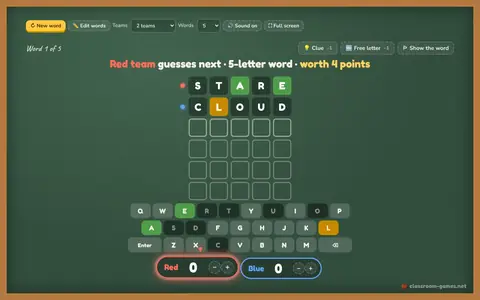 Guess the WordWordle with your own spelling words, hints and team turns.▶ Play now
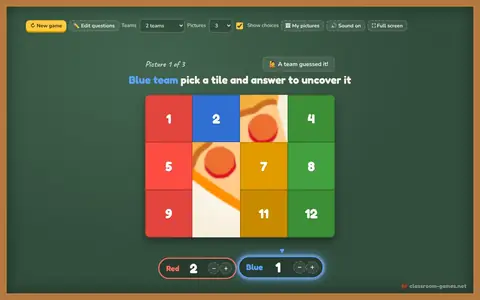 Mystery PictureAnswer questions to remove tiles. First team to guess the picture wins.▶ Play now
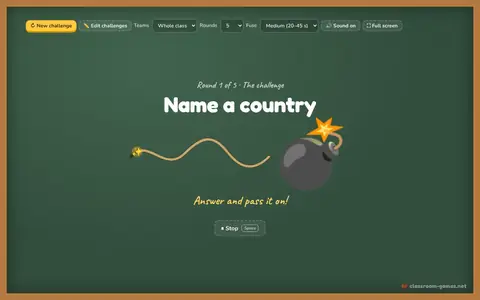 Pass the BombA hidden random fuse, a challenge and a ball to pass. Boom!▶ Play now
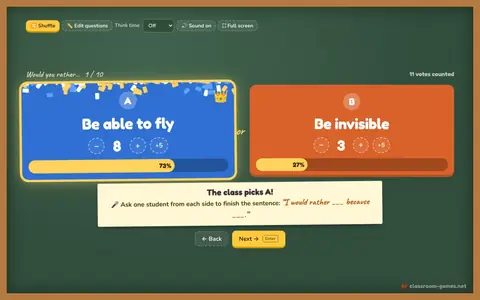 Would You Rather VoteBig A vs B choices, count the votes, reveal the result.▶ Play now
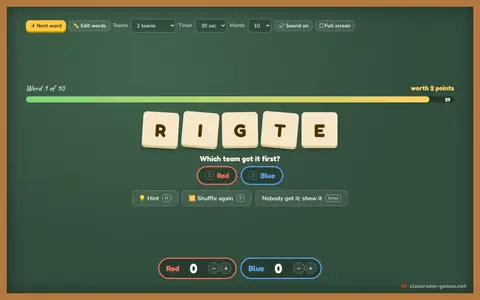 Word ScrambleUnscramble the letters before the timer runs out.▶ Play now
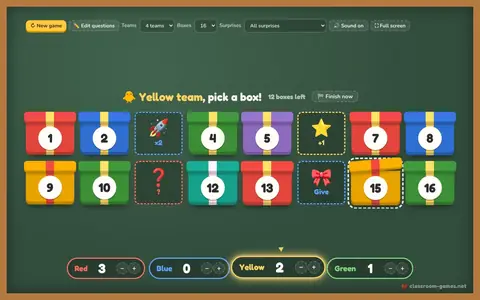 Lucky BoxesPick a box, answer right, open it: points, steal, swap or 💣.▶ Play now
 Team RaceAnswer right to move your racer. First to the flag wins. Or play tug of war.▶ Play now
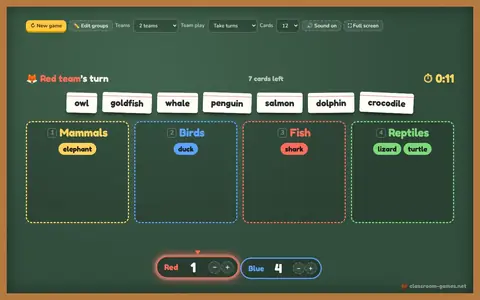 Sort ItDrag each card into the right group on the board. Teams or beat the clock.▶ Play now
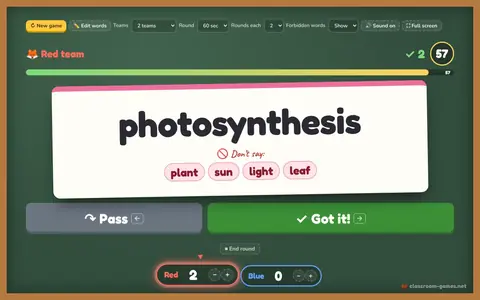 Heads UpBig word cards, 60-second rounds, ✓ got it or ↷ pass. Charades and Taboo too.▶ Play now
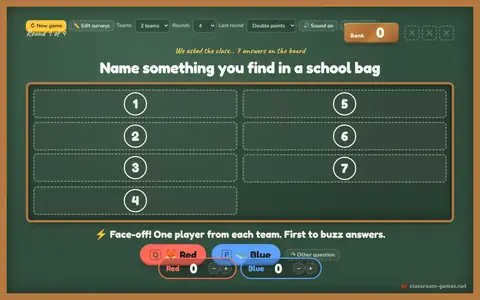 Survey SaysGuess the top survey answers. Face-off, three strikes, steal the bank.▶ Play now
Board tools
Questions teachers ask
Trashketball, Jeopardy review, Quiz Quiz Trade, Would You Rather and the Marshmallow Challenge are reliable hits with grades 6–8.
Have every student or team answer every question on whiteboards, award points for correct answers, and add a small bonus (like a trash can shot) so knowledge still decides the winner.
Explore