Review games
20 Questions
The class asks up to 20 yes-or-no questions to figure out a secret person, place or thing.
By type
A good review game keeps every student thinking on every question, not just the one who raises their hand fastest. These formats work with any set of questions, so you can reuse them all year.
The class asks up to 20 yes-or-no questions to figure out a secret person, place or thing.
Two students race to answer a flash card.
Teams line up and take turns running to the board to answer one step of a problem, then hand the marker to the next teammate.
Students count around the room but say "Buzz" instead of any multiple of a chosen number.
Students estimate how many candies are in a jar, explain their strategy, then count together.
Pick a letter and a list of categories.
Students act out a word or phrase without speaking while their team guesses.
Each student says a four-character Chinese idiom (chengyu) that starts with the last character of the one before it, such as 一心一意 → 意气风发 → 发奋图强.
Students mark answers on a bingo card as you read clues.
Students find as many words as possible in a grid of letters.
Teams solve a chain of puzzles built from your unit content to unlock the final "lock" before time runs out.
Students search the room for hidden clues or items, answering questions to unlock the next clue.
A student describes a vocabulary word to their team without saying the word or any of the "taboo" words listed on the card.
Two teams answer questions to drop a colored token into a grid on the board.
Teams hear surprising statements and decide whether each one is fact or fiction.
Teams guess the same bowl of words in three rounds: first with any clues, then with one-word clues, then with acting only.
Two students race to swat the correct answer on the board with a fly swatter.
Students tiptoe to one of four labeled corners while a caller with eyes closed picks a corner.
Teams answer review questions to win the right to erase X's from other teams, then take a bonus shot at a trash can to erase even more.
Students guess letters to reveal a hidden word before the drawing is complete.
One student holds a word card to their forehead without looking at it, and classmates give clues until they guess the word.
The class guesses whether the next card or number will be higher or lower than the last one, showing their guess with their hands or by moving.
Students pass an object around while music plays.
One student sits with their back to the board while teammates describe the word written behind them.
Students stand in two circles facing a partner, answer a question together, then the outer circle moves on to a new partner.
Color-code Jenga blocks to question cards.
A quiz-show board of categories and point values where teams pick a square and answer the question behind it.
Students take turns pulling craft sticks from a cup and read the word or answer the question on each one, keeping every stick they get right.
The teacher says a word loudly and the class repeats it quietly, or says it quietly and the class says it back loudly.
Teams "bat" by answering questions: easy for a single, harder for a double, hardest for a home run.
Pairs flip playing cards and race to add or multiply them.
Students flip cards two at a time to find matching pairs, such as a word and its definition.
A student feels an object inside a bag without looking and describes it while classmates guess.
Show four words, numbers or pictures and ask students which one does not belong and why.
A gift wrapped in many layers is passed around while music plays.
One student draws a word on the board while their team guesses it before time runs out.
A Halloween twist on hot potato: pass a small pumpkin around the circle while music plays, and whoever holds it when the music stops answers a question.
Each student holds a question card, quizzes a partner, gets quizzed back, then trades cards and finds a new partner.
Students answer the task card on their desk, then "scoot" to the next desk on your signal and answer the next card.
Students write an answer or question on paper, crumple it up and throw it across the room.
Students spell a word aloud one letter at a time around the circle.
Students take turns spelling words aloud.
Read a statement.
Two teams play tic-tac-toe on the board, but must answer a question correctly to place their X or O.
The teacher picks a row of students as the "train", and each student answers in turn without a pause, like cars passing one after another.
Teams answer review questions, and every correct answer earns a shot at the trash can for bonus points.
Every student writes an answer on a mini whiteboard, and the whole class holds their boards up at the same moment on the teacher's "Showdown" signal.
A student holds a card to their forehead without seeing it and asks yes-or-no questions to figure out which person, animal or term they are.
Run a quiz show with mini whiteboards: every student answers every question at the same time, so nobody sits out.
Teams race to unscramble vocabulary words.
Quick picks
Play online
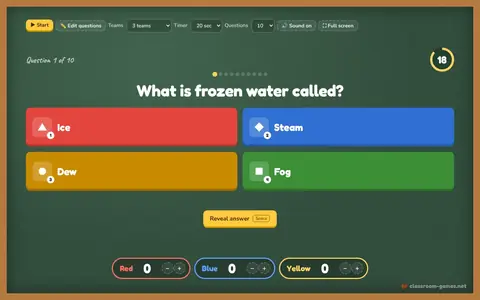 Quiz ShowKahoot-style questions with colors, a countdown and team points. No student devices.▶ Play now
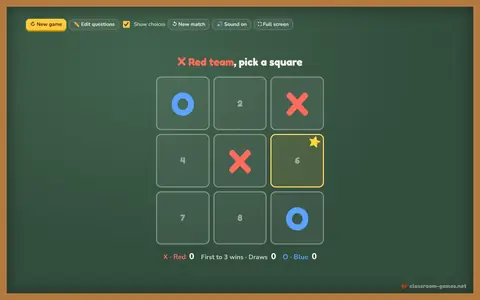 Tic Tac Toe ReviewAnswer a question to claim the square. Red X vs Blue O.▶ Play now
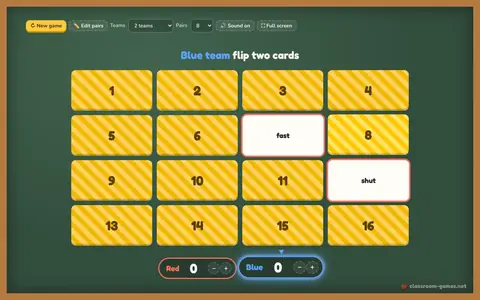 Memory MatchFlip two cards, find the pair. Words, facts or translations.▶ Play now
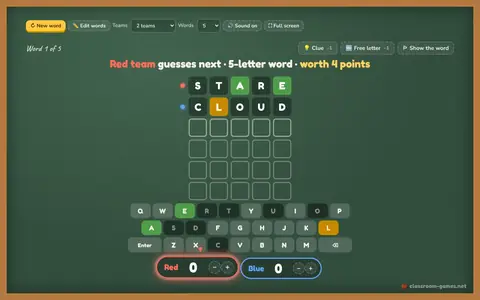 Guess the WordWordle with your own spelling words, hints and team turns.▶ Play now
 Mystery PictureAnswer questions to remove tiles. First team to guess the picture wins.▶ Play now
 Pass the BombA hidden random fuse, a challenge and a ball to pass. Boom!▶ Play now
 Would You Rather VoteBig A vs B choices, count the votes, reveal the result.▶ Play now
 Word ScrambleUnscramble the letters before the timer runs out.▶ Play now
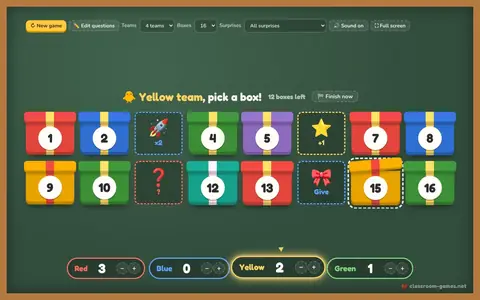 Lucky BoxesPick a box, answer right, open it: points, steal, swap or 💣.▶ Play now
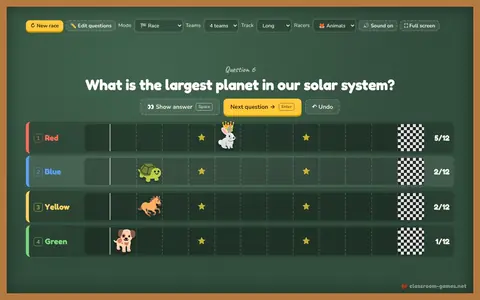 Team RaceAnswer right to move your racer. First to the flag wins. Or play tug of war.▶ Play now
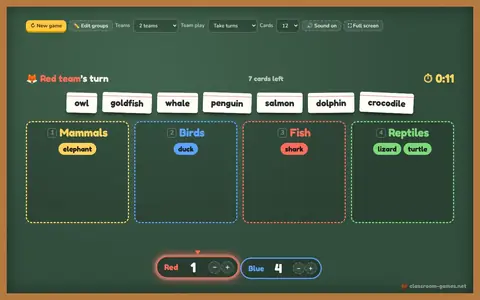 Sort ItDrag each card into the right group on the board. Teams or beat the clock.▶ Play now
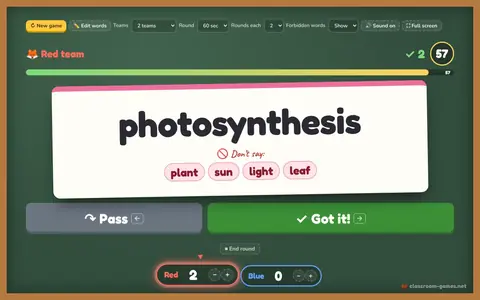 Heads UpBig word cards, 60-second rounds, ✓ got it or ↷ pass. Charades and Taboo too.▶ Play now
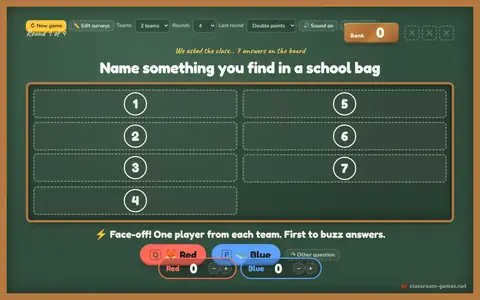 Survey SaysGuess the top survey answers. Face-off, three strikes, steal the bank.▶ Play now
Board tools
Questions teachers ask
Trashketball and Jeopardy are the most popular. For maximum participation, have every team answer every question on whiteboards.
Use mini whiteboards, a projected scoreboard and a timer. The Whole-Class Quiz Show and Quiz Quiz Trade need no devices at all.
Explore